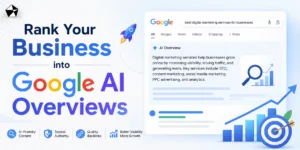

To really benefit from this, you need to understand that there are different types of snippets. This is where many people get confused. Rich snippets and featured snippets sound similar and are often used interchangeably, but they work differently, appear in different ways, and require different strategies. A digital marketing company in Bhubaneswar can help you avoid this confusion and apply the right strategy early on.
What Is the Difference Between Rich Snippets and Featured Snippets in SEO?
Think of it this way.
A rich snippet is your regular Google result, just upgraded. It might show ratings, prices, images, or other useful details. It still sits in the normal list of results, but it grabs more attention. This happens when your page uses structured data to help Google read it better.
The six common types of rich snippets are:
- Review snippets display star ratings and review counts, pulling from structured review data. Widely used for products, services, and local businesses.
- Recipe snippets show cooking time, calorie count, ratings, and sometimes an image among the highest-performing snippet types for food-related content.
- Product snippets show price, availability, and ratings directly in the search result—standard for e-commerce.
- Event snippets display date, time, and location for events, concerts, and seminars.
- FAQ snippets expand your search result by surfacing multiple questions and answers from the page, giving it far more visibility than a typical listing.
- How-to snippets break a process down into individual steps and can include a supporting image for each one.
A featured snippet is the box at the top of Google search results where Google pulls a direct answer from a page and displays it before everything else. It usually appears as a short paragraph, a list, or a quick step-by-step answer.
Google uses four main formats for featured snippets, and each suits a different kind of query:
- Paragraph snippets are the ones you’ll come across most often. If you’ve ever searched “what is” something and got a quick answer right at the top, that’s exactly what it is. Google finds a clear paragraph on the page and surfaces it directly.
- List snippets are more structured. They show up as steps or bullet points, which makes them perfect for guides and “top” lists.
- Table snippets show up when comparisons are needed, pulling data directly from structured tables.
- Video snippets are often taken from YouTube and take you right to the part of the video that answers your question.
So the difference is simple. Rich snippets improve how your result looks, while featured snippets give your content prime visibility at the top. Both are powerful, but they are earned in very different ways.
Do Rich Snippets Improve Click-Through Rates More Than Featured Snippets?
It really comes down to the query. Rich snippets usually improve click-through rates because they stand out with ratings, prices, or other visual details. Featured snippets work a little differently. For more detailed queries, they can bring in strong clicks because users want more context. However, if it’s something simple, like “what is the capital of Odisha,” the snippet usually answers it completely, and users move on without clicking. That’s what’s called a zero-click search, and it can limit traffic for very simple content. This is why targeting the right query type matters as much as the optimisation itself.
You May Like: Google’s New MUVERA Algorithm: What It is and Why It Matters for Your Business
How Can a Digital Marketing Company in Bhubaneswar Help My Site Get Featured Snippets?
You can’t pay your way into a featured snippet, and there’s no secret hack either. Google picks whatever answers the query best, plain and simple. The pages that keep landing that spot usually look like this:
- Most of them already sit somewhere on the first page of results for that query.
- The question gets answered straight away, usually before the reader gets too far down the page.
- Headings are written the way a real person would ask the question, not stuffed with keywords.
- Lists and tables appear where they make sense, not just for the sake of formatting.
- The content actually goes deep enough on the topic that Google feels like it can trust it.
At the end of the day, getting featured snippets comes down to answering the right questions clearly and in a way that’s easy for Google to pick up. This is where a specialist helps, since it involves research, content planning, and ongoing tracking. Technovate works with businesses on improving search visibility like this. If featured snippets are missing from your strategy, it may be worth discussing with their team.
Optimised but Invisible: Why Google Still Won’t Feature Your Content?
So you’ve done everything right, and your content still isn’t showing up as a featured snippet. Frustrating, isn’t it? Here’s what’s likely happening.
For starters, Google only picks pages that already appear on page one, so if you’re not there yet, that needs to be addressed first. After that, it comes down to how your page is laid out. If the answer is hard to find, Google will have trouble pulling it out, too. There also needs to be enough high-quality content around it to back it up so Google feels confident featuring it. Sometimes the search term itself just does not trigger a featured snippet at all.
Which Is Better for SEO: Rich Snippets or Featured Snippets?
Honestly, it comes down to the page itself. A page focused on products, reviews, or events will benefit more from rich snippets. Featured snippets are a better focus when the content answers questions people are asking before they make a decision, things like how-to guides, FAQs or comparison pages.
The best SEO strategies simply do both. Schema markup runs across the site, while the content shapes to target featured snippet positions for key informational queries in the niche.
Wrapping It Up
Rich snippets and featured snippets serve different purposes, but together they make a real difference in how a site shows up in search. One polishes the result, the other elevates it.
As a trusted digital marketing company in Bhubaneswar, Technovate knows exactly where to look for snippet opportunities and ensures everything is in place to pursue them. So if you’re not sure where to start, that’s fine. That’s exactly what the first conversation is for. Let’s talk and figure out where to start.
Frequently Asked Questions
- Can I pay Google to show my content as a featured snippet?
No, featured snippets cannot be bought or influenced through ad spend, as Google selects them purely based on how clearly and accurately the content answers a search query.
- Do rich snippets and featured snippets work for all types of businesses?
Rich snippets work best for product, review, and event-based pages. In contrast, featured snippets are more suited to businesses that create informational content targeting questions their audience searches before making a decision.
- How long does it take to start seeing results from snippet optimisation?
There is no fixed timeline, as it depends on the current ranking position, content quality, and how competitive the target queries are, but pages already on page one with well-structured content tend to see results faster.